INTRODUCING HIGH PRECISION GUARANTEE SEAL
SETTING A NEW BENCHMARK IN WATCHMAKING EXCELLENCE
KEY FACTS:
Expressing the Manufacture-Atelier’s core philosophy: a new quality seal of the Manufacture-Atelier Jaeger-LeCoultre to guarantee a high level of chronometric precision and high standards of watchmaking finishes, testimony of constant innovation while upholding the traditional values of fine watchmaking
Precision of Chronometry: a new seal of quality, supported by an integrated, patented* testing protocol designed to simulate the stresses of real-world conditions
Precision of Finishes: a qualitative guarantee of fine movement finishing and decoration
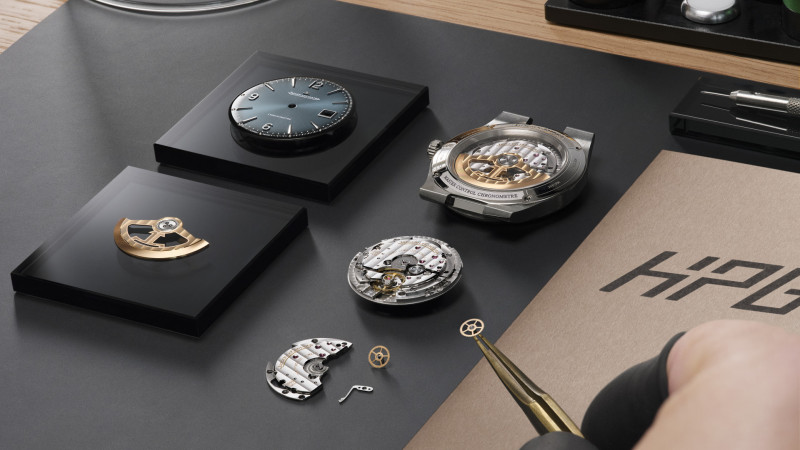
In keeping with its constant quest for precision and innovation, Jaeger-LeCoultre introduces its High Precision Guarantee (HPG) Seal, a new proprietary standard of watchmaking excellence. Applied to every single watch through an exhaustive testing and inspection process, the HPG Seal is certified by a quality seal on the caseback. It combines two fundamental dimensions of fine watchmaking: Precision of Chronometry, tested under conditions designed to simulate real-world wear and Precision of Finishes, guaranteeing that movement finishing and decoration meet the Manufacture-Atelier’s required standards.
Having debuted at Watches and Wonders 2026 with the Master Control Chronometre collection, Jaeger-LeCoultre’s HPG Seal embodies the Maison’s philosophy of constant innovation while upholding the traditional values and savoir-faire of fine watchmaking. The HPG Seal will be progressively extended across all Jaeger-LeCoultre collections.
CHAPTER 1: CONSTANT QUEST FOR TIMEKEEPING PRECISION: THE HISTORY OF HALLMARKS
The genesis of Maritime Precision: The quest for chronometric precision gained decisive momentum with the rise of global seaborne trade in the late 17th century. Accurate measurement of longitude required clocks capable of maintaining exceptional precision at sea, leading to major advances in marine chronometry throughout the 18th century and establishing the foundations of modern precision timekeeping.
Pioneering marine timekeeping: Among the pioneers was Edmond Jaeger, whose expertise in precision watchmaking was already well established by the late 1880s. In the early 1900s, his Torpedo Boat watches distinguished themselves in official timing competitions for their reliability and accuracy. His expertise later earned him the prestigious title of “Horloger de la Marine de l’État” - “Watchmaker to the State Navy”, reflecting his contribution to precision instruments for naval use.
International Recognition: In the late 19th century, Antoine LeCoultre gained growing international recognition for his expertise in chronometric precision. His participation in major international exhibitions, notably in Paris and London, where his work was awarded medals, brought greater visibility to his achievements and helped establish his reputation on the international stage. These distinctions notably recognised the high degree of precision and quality of finishing achieved in mechanically produced calibres, demonstrating how technical performance could be combined with increasingly sophisticated manufacturing methods. As reflected in the medal table in the Maison’s Heritage Gallery, these awards contributed to establishing Jaeger-LeCoultre’s reputation for technical excellence and innovation in watchmaking.
Expanding fields of expertise: As advances in chronometry opened new possibilities, watchmakers were called upon to meet the requirements of increasingly demanding environments. The effects of gravity on timekeeping presented a fundamental technical challenge, inspiring increasingly sophisticated solutions. In the 1940s, aviation brought its own requirements, leading to the development of pilot’s watches designed for optimal legibility, robustness and reliable performance in demanding flight conditions. In 1948, Jaeger-LeCoultre launched the Pilot Mark XI, which would become one of the Maison’s most renowned aviation watches and an enduring expression of expertise in its field. Across land, sea and air, these evolving challenges continued to drive advances in watch design, functionality and chronometric performance.
Validated by Observatory Trials: As chronometric performance became an increasingly important measure of watchmaking excellence, observatory trials provided a rigorous framework in which Manufactures could demonstrate their expertise. Leading observatories in Geneva, Neuchâtel and Besançon subjected timepieces to rigorous trials, with Manufactures competing to demonstrate their chronometric expertise. In 1946, Jaeger-LeCoultre’s first tourbillon-equipped pocket watch, Calibre 170, won the prestigious Neuchâtel Observatory chronometry competition.
By the end of the 1960s, the rise of quartz technology transformed the watchmaking landscape and traditional observatory competitions gradually lost their central role. A new framework for certifying mechanical precision emerged with the creation in 1973 of the Contrôle Officiel Suisse des Chronomètres (COSC), which established an independent benchmark for Swiss chronometer certification.
Safeguarding the Geneva legacy: Alongside chronometric certification, hallmarks have long served to guarantee provenance, quality and workmanship. Geneva established the world’s first watchmakers’ guild, the Maîtrise des Horlogers de Genève, in 1601, and in 1886 the Grand Council of Geneva introduced the Poinçon de Genève (Geneva Seal) to protect the reputation and standards associated with Geneva watchmaking. Over time, this tradition of independent certification also inspired leading Manufactures to develop their own proprietary standards and seals. In 1992, this pursuit led to the creation of the 1,000 Hours Control, a demanding in-house testing protocol designed to assess the performance and reliability of the fully assembled Jaeger-LeCoultre watches.
CHAPTER 2: THE MANUFACTURE-ATELIER, MASTERING PRECISION AT EVERY STEP
Mastering excellence at every step: At the Manufacture-Atelier, mastery extends across every stage of watchmaking - from the production of each component to the final assembly and finishing of every timepiece. Throughout manufacturing, including the machining of even the smallest parts, rigorous quality controls guarantee uncompromising precision. Yet Jaeger-LeCoultre’s ambition has always gone beyond mastering production alone: the goal is to create watches that are not only impeccably crafted, but also among the most precise and reliable in everyday wear.
A pioneering vision of precision: Since 1833, Jaeger-LeCoultre has pursued precision as a defining principle of its watchmaking. The invention of the Millionomètre in 1844, the first instrument capable of measuring the micron, enabled ever greater accuracy in the creation of components and increasingly sophisticated calibres.
This mastery naturally extended to chronometric performance, finding expression in wristwatches such as the Futurematic and Geophysic in the 1950s. In 1970, the Polaris II gave this longstanding pursuit a name: “High Precision Guarantee”, displayed on its dial as a signature of its innovative 4Hz calibre.
In 1992, the launch of the Master Control marked a significant milestone with the introduction of the 1,000 Hours Control. This rigorous testing protocol was designed to assess the performance, reliability and quality of each fully assembled watch, setting a new benchmark for precision and excellence.
A new level of high precision: More than five decades after the “High Precision Guarantee” designation first appeared, Jaeger-LeCoultre brings this historic name into a new era with the HPG Seal. Drawing on the Manufacture-Atelier’s mastery of every stage of creation and decades of expertise in testing and chronometric performance, it introduces a new proprietary standard for Jaeger-LeCoultre timepieces.
Its rigorous certification process combines multiple tests performed through an innovative, integrated protocol, validating the precision, reliability and quality of each timepiece. At the same time, the HPG Seal guarantees the exacting standards of movement finishing that are inseparable from Jaeger-LeCoultre’s vision of Haute Horlogerie.
By bringing together integrated manufacturing expertise, rigorous testing and exceptional finishing, the HPG Seal represents the latest expression of Jaeger-LeCoultre’s constant pursuit of precision and excellence. Every HPG-certified timepiece undergoes the complete testing protocol, ensuring that each individual watch meets Jaeger-LeCoultre’s exacting standards.
CHAPTER 3: A NEW SEAL OF PRECISION, QUALITY AND RELIABILITY
Simulating extreme wear: Evaluating real-world timekeeping performance, the new HPG Seal tests timepieces under four critical conditions. The first test is performed on the calibre alone, while the remaining three are conducted on the fully cased watch:
Altitude*: Simulates atmospheric pressure variations from sea level to 1,004 meters (the elevation of Jaeger-LeCoultre’s Manufacture-Atelier in Le Sentier).
Multi-directional Shocks: Applies impacts ranging from 25G to 50G across multiple standardised positions.
Positions: Alternates periods of multi-position motion and fixed resting positions.
Temperature: Replicates fluctuations from 18°C (simulating rest) to 35°C (simulating active physical movement).
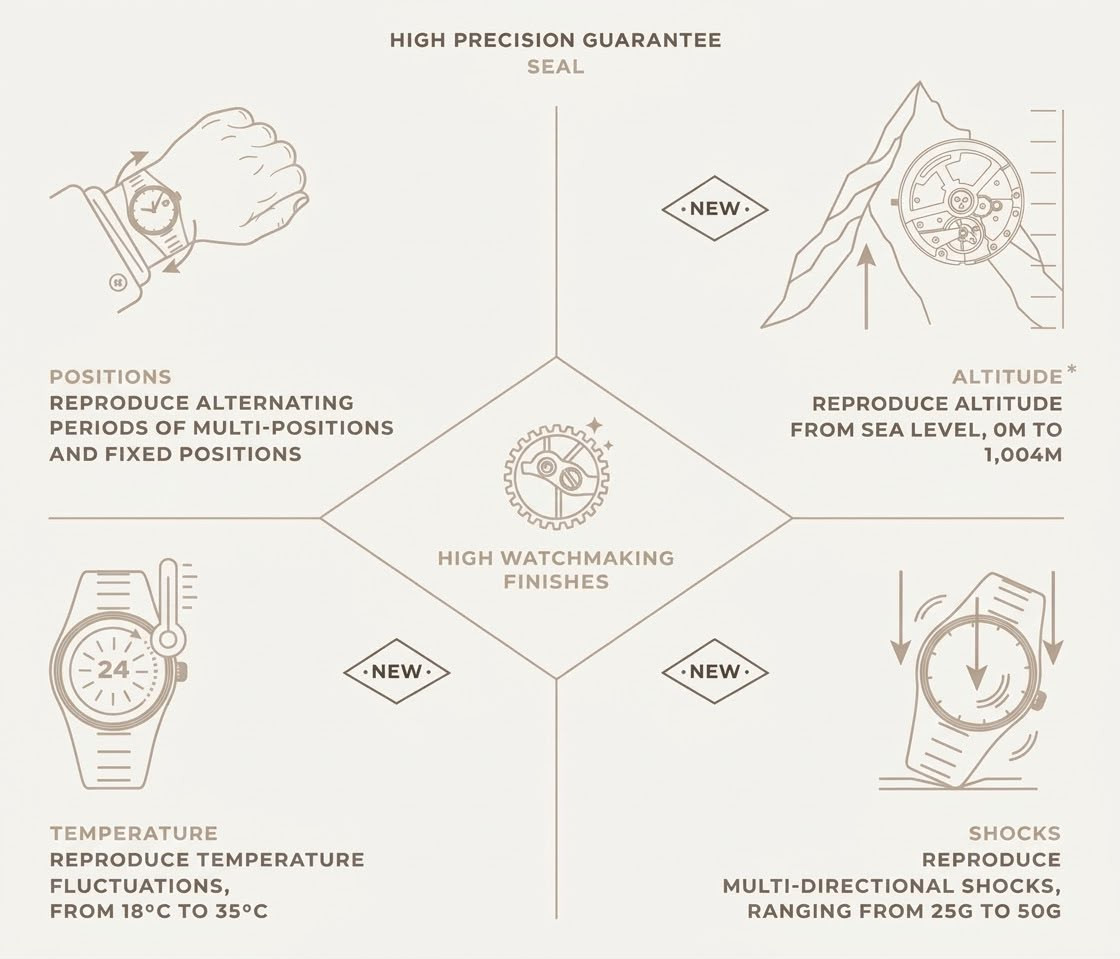
*Performed on the calibre alone
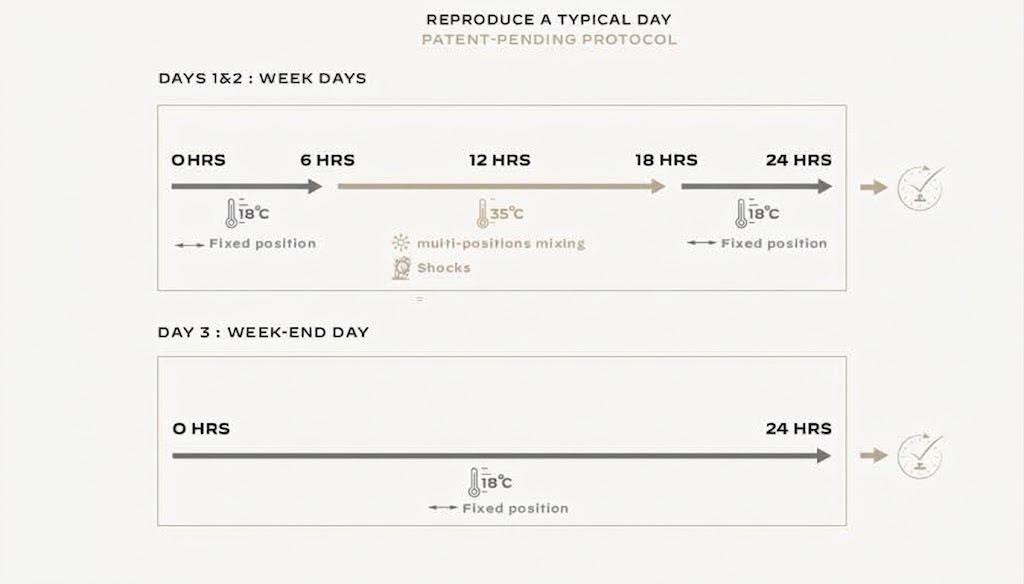
The Patented* Dynamic Protocol: Rather than assessing these parameters in isolation, a custom-developed HPG machine subjects each timepiece to alternating cycles where various stresses are applied simultaneously. Two days of dynamic wear cycles replicate the movements of active weekdays, combining fixed positions, multi-position motion, shocks and temperature changes. On the third day, the timepiece enters a "stabilized rest" cycle in a fixed position, mimicking a watch resting over the weekend. This integrated, patented* protocol ensures the watch maintains chronometric accuracy throughout the full spectrum of a wearer's life, far beyond ideal laboratory conditions.
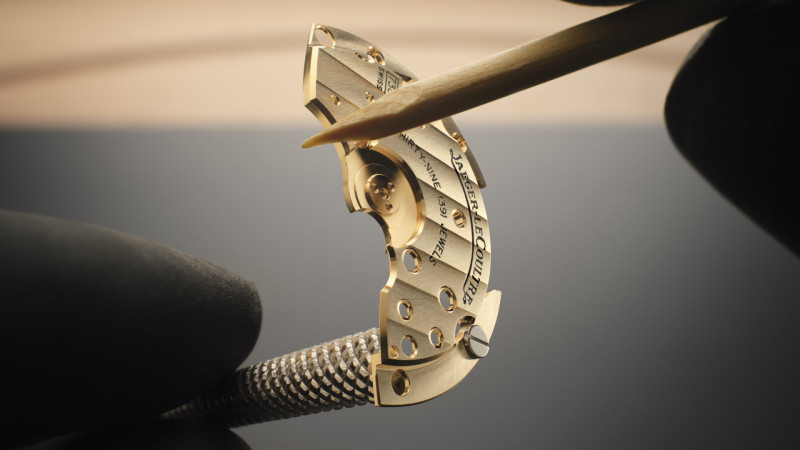
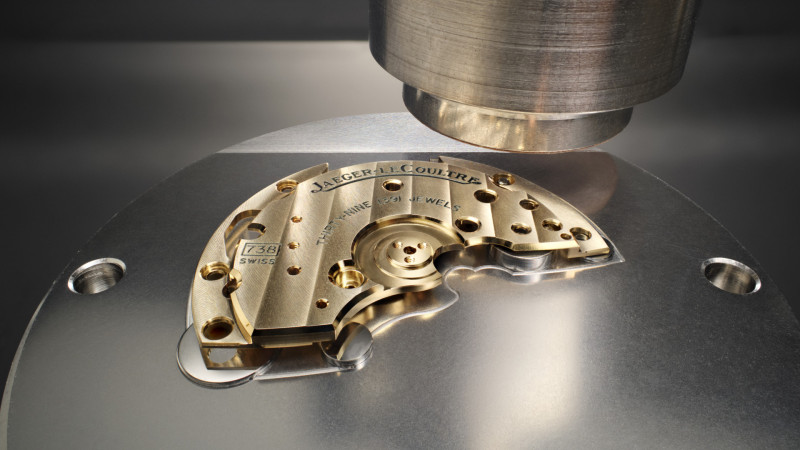
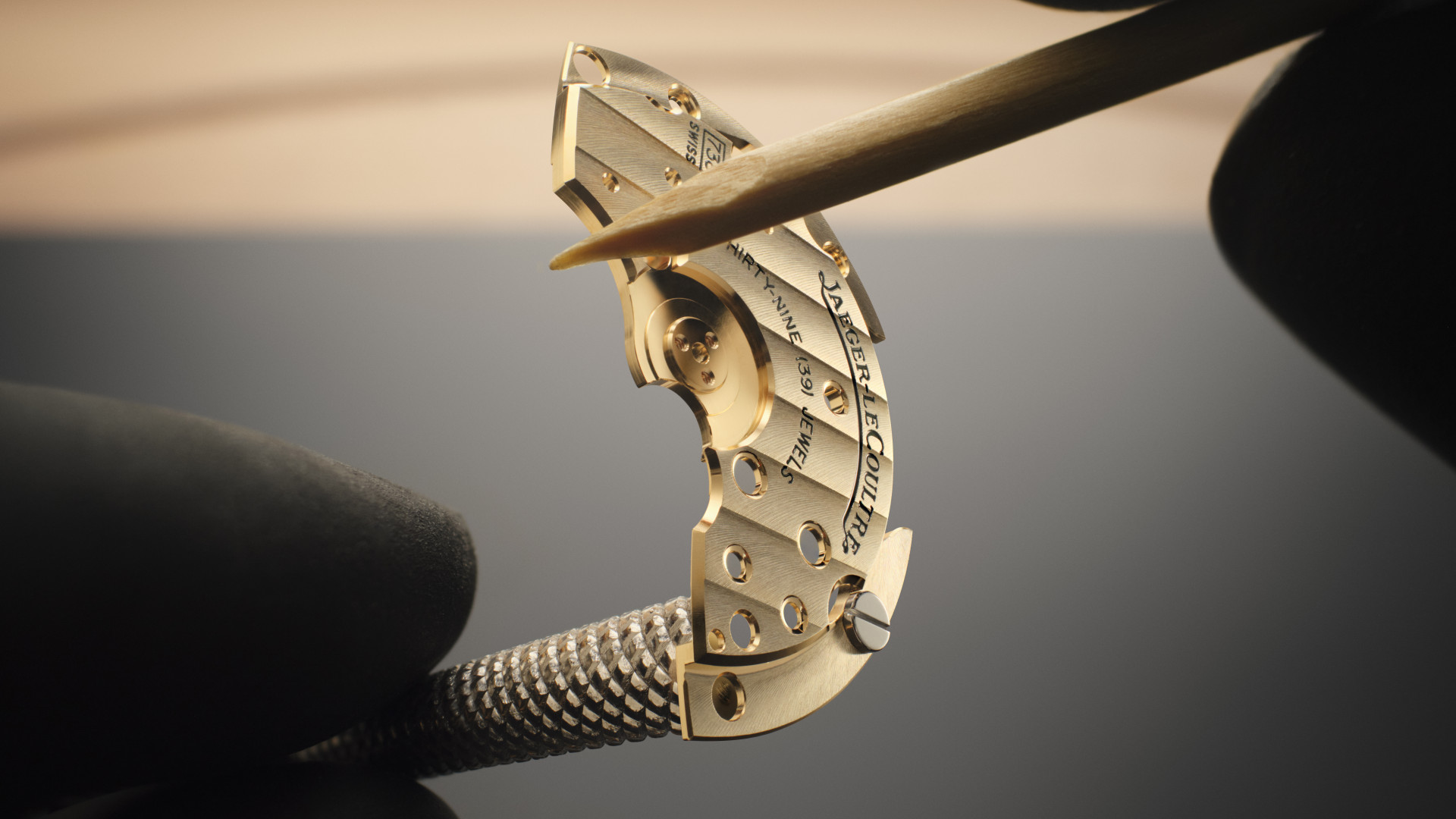
Beauty, beyond precision: Beyond precision and durability, the High Precision Guarantee (HPG) Seal recognises an exceptional standard of movement finishing – an art that originally served to reduce friction and glare but evolved in the 18th and 19th centuries into a beautiful play of light. For Jaeger-LeCoultre, fine finishing is inseparable from precision: it must be executed to micron-perfect accuracy to enhance movement performance while highlighting the beauty of the mechanism. To qualify for the High Precision Guarantee (HPG) Seal, a watch must incorporate at least six of these eight traditional finishing techniques:
Bevelling: Shaving and polishing the 90-degree edges of components to a mirror-like shine.
Burnishing: Compressing and polishing metal components, particularly pivots, to enhance durability and surface hardness.
Circular smoothing: Using fine abrasives to create a smooth, matte circular texture.
Linear Smoothing: Using fine abrasives to draw uniform, parallel matte lines along flat surfaces.
Counter-sinking Jewels: Creating polished, chamfered recesses around jewel holes in plates or bridges to ensure a perfect fit and help retain lubrication.
Côtes de Genève: Applying parallel wave-like patterns to large components to diffuse light and trap microscopic dust.
Perlage (Circular Graining): Placing overlapping circular patterns on plates and bridges to diffuse reflections.
Polished Screw-heads: Polishing the head of every screw to create a perfectly flat, reflective surface.
CHAPTER 4: A NEW CHAPTER FOR HIGH PRECISION GUARANTEE
Having introduced the High Precision Guarantee (HPG) Seal with the Master Control Chronometre collection at Watches & Wonders Geneva in April 2026, Jaeger-LeCoultre will gradually expand the certification across its collections, beginning in 2027. For its debut with the Master Control Chronometre collection, each calibre was first COSC-certified before undergoing Jaeger-LeCoultre’s more comprehensive HPG testing protocol, further raising the standards of precision, quality and reliability.
With its dual focus on timekeeping precision and refined decorative artistry, the High Precision Guarantee Seal encapsulates Jaeger-LeCoultre’s commitment to the values of traditional Haute Horlogerie, while continuously innovating and evolving its collections.
*Patent pending