

INTRODUCING DUOMETRE GRANDE COMPLICATION A GRANDE SONNERIE
A NEW INTERPRETATION OF CALIBRE 182
KEY FACTS:
15 Complications: Westminster-style chimes mark the quarters and hours in a Grande and Petite Sonnerie and minute repeater; a retrograde perpetual calendar and flying tourbillon unite in a movement comprising 1,300 parts
Grand Sonnerie Calibre: 4 gongs and 4 hammers chiming every quarter hour en passant showcasing exceptional savoir-faire in chiming watches
Technical advances: a titanium inner case and newly designed metallic glass gongs enhance acoustics; a new security measure for the chiming mechanism increases resilience
A fresh aesthetic: a new design for the open-worked dial reveals more of the movement’s beauty
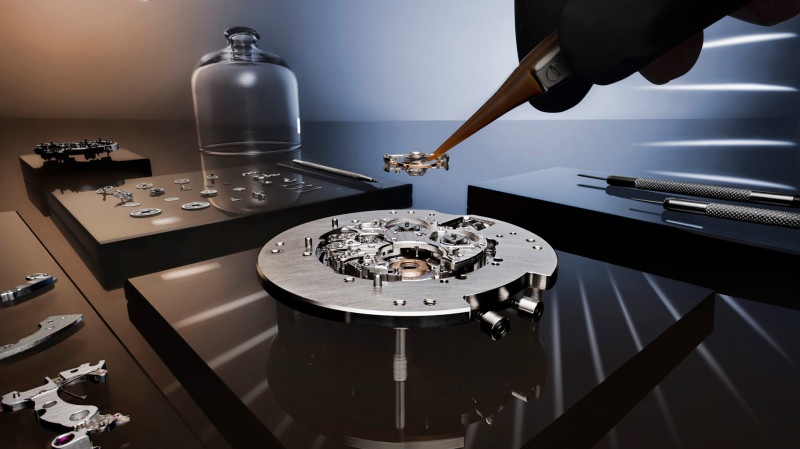
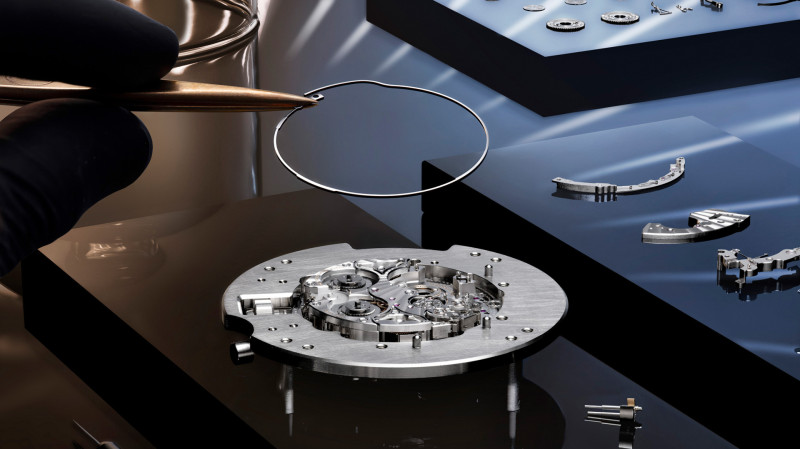
Jaeger-LeCoultre presents the Duometre Grande Complication A Grande Sonnerie, a new interpretation of Calibre 182, the Maison’s first chiming Grande Complication for the wrist. Introduced in 2009 in the Hybris Mechanica A Grande Sonnerie, Calibre 182 broke new ground in watchmaking. Incorporating a Grande Sonnerie with Westminster-style chimes – the most rarefied of all chiming mechanisms – a Petite Sonnerie and a Minute Repeater, as well as a retrograde perpetual calendar, flying tourbillon and two power reserve indicators – it was not only one of the most complicated wristwatch ever made at the time but also harnessed the innovative Duometre system (invented by Jaeger-LeCoultre in 2007) to manage the calibre’s extreme demands for energy. Due to the extreme complexity of Calibre 182, very few examples were made: with some 1,300 parts, it takes a full year only to assemble and regulate the movement and involves four phases with a total of 16,000 different operations: assembly; disassembly; corrections and cleaning; final assembly.
Now, with benefit of significant technical advances, focusing on improving the acoustic quality of the chimes and enhancing the robustness of the movement, Jaeger-LeCoultre presents a new interpretation of Calibre 182. The subject of eight patents, including six for developments specific to Calibre 182, the fully integrated movement incorporates 15 complications. The watch carries a ninth patent, for the micro-adjustment mechanism on the buckle of the alligator strap.
HARNESSING A GREAT LEGACY IN CHIMING WATCHES
The Watchmaker of Watchmakers™: For more than 150 years, chiming watches have been a particular forte of Jaeger-LeCoultre, complementing its renowned expertise in other classic complications, the Maison has developed more than 200 different chiming watch calibres, mastering all forms from relatively simple alarms to Grandes Sonneries and Westminster chimes. After creating its first minute repeater in 1870, Jaeger-LeCoultre became known as The Watchmaker of Watchmakers™️, supplying chiming movements to many of the most exalted names in watchmaking while continually innovating to improve the mechanical efficiency, clarity and beauty of its sound, from cathedral gongs and the silent strike governor to crystal gongs, trebuchet hammers and duplex gongs. Today, the Grande Sonnerie represents the ultimate sonnerie challenge, chiming every hour and quarter hour automatically while demanding exceptional power management, precision and mechanical complexity, placing it at the pinnacle of complicated watchmaking.
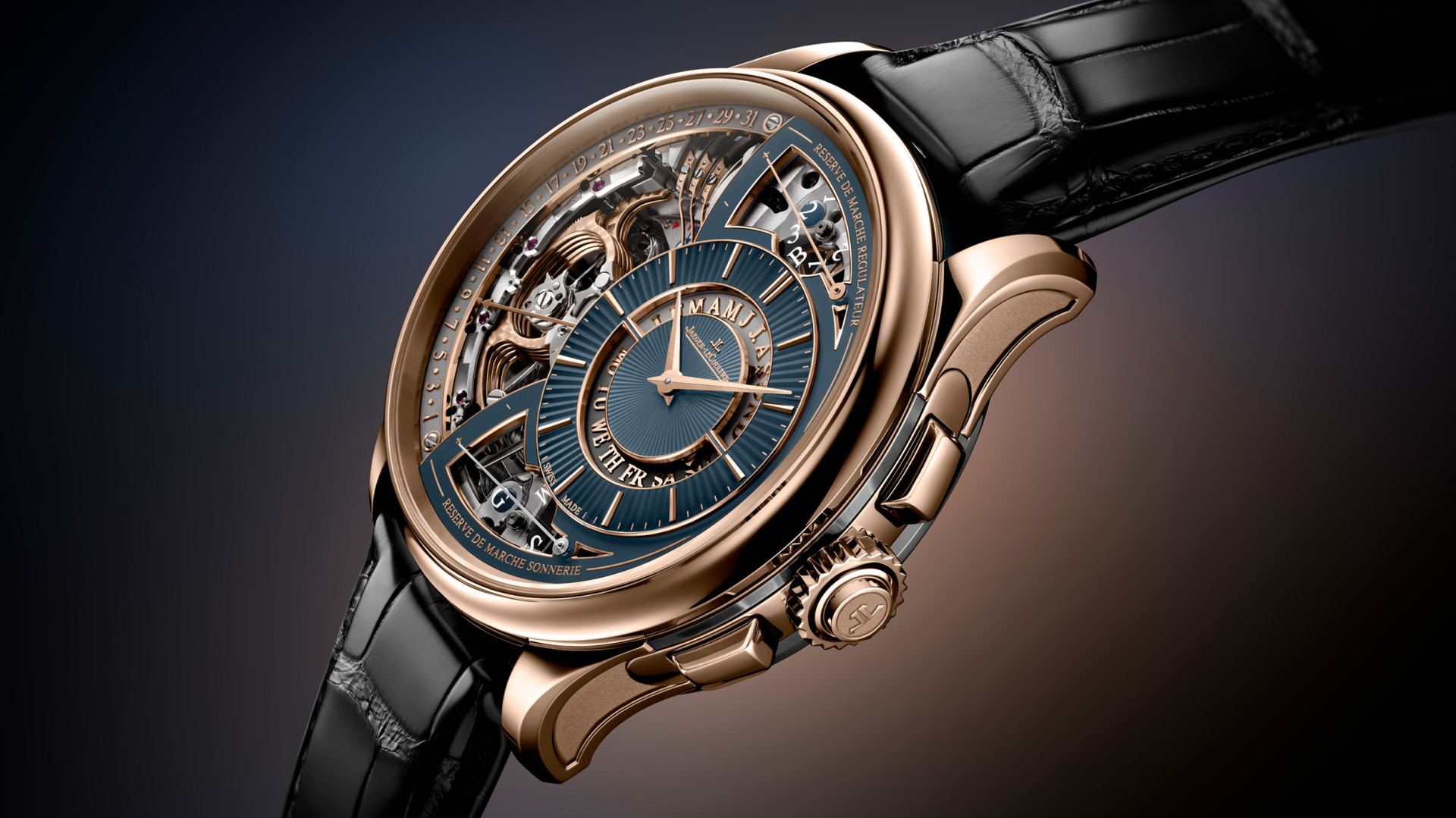
CALIBRE 182: 15 COMPLICATIONS BUILT ON THE DUOMETRE CONCEPT
To create the original Calibre 182 required more than five years of intensive research and development – harnessing the Manufacture’s preceding century-and-a-half of accumulated savoir-faire in chiming watches. Offering three different ways of chiming time, Calibre 182 unites this highly complex striking mechanism with a perpetual calendar indicating the date, month and day of the week in retrograde displays and the leap years in a digital display at 12 o’clock on the dial. Like all perpetual calendars, it automatically accounts for months of different lengths as well as leap years and, if it remains wound, will need no manual adjustment until 2100 (a century year that is not also a leap year.) The calibre is enhanced by a flying tourbillon regulator and features two distinct power reserve displays – one for each of the main barrels.
Two independent energy sources: Due to the critical importance of power management, a dual-barrel movement architecture is a crucial to a Grande Sonnerie calibre. For Jaeger-LeCoultre, it was natural to build Calibre 182 on the Duometre mechanism, which it invented in 2007. This concept resolves a fundamental conundrum of watchmaking: how to maintain a perfect flow of energy to ensure precise timekeeping while adding complications that require extra bursts of energy – which inevitably compromise that regular flow. A Duometre mechanism has two barrels, each with a separate and independent gear train, housed within a single calibre and linked to a single regulating organ. In the case of Calibre 182, one barrel provides energy to the gear train that powers the time and perpetual calendar indications and the other to the gear train that drives the chiming functions, thus ensuring that their operation has no impact on timekeeping accuracy.
The barrel dedicated to the timekeeping and calendar functions provides a 48-hour power reserve; the barrel dedicated to the chiming mechanism provides sufficient power in Grande Sonnerie mode for a total of 616 notes (equivalent to seven hours and 30 minutes of continuous chiming) and in Petite Sonnerie mode for a maximum of 992 notes – equivalent to 32 hours of chiming. In addition to the standard two-barrel Duometre configuration, Calibre 182 has a third barrel. It replaces the trigger's winding motion, since the latter is replaced by a push-button on the crown.
THE CHIMES: DISTINCTIVE MELODIES WITH ENHANCED TONAL QUALITIES
Three ways to chime: Because Calibre 182 is fitted with four gongs and four hammers — instead of the usual two gongs in minute repeaters and most sonnerie movements — it is able to play four different notes (in various combinations) in the manner of the Westminster chime – the famous melody of London’s Big Ben. Adding to the distinctive character of Calibre 182, Jaeger-LeCoultre’s watchmakers made the unusual choice to have the Grande Sonnerie and the Petite Sonnerie sound the quarter-hour melody first, followed by the corresponding hours; conversely the minute repeater follows the standard sequence of hours, quarters and minutes.
616 notes, 7 and a half hours: Calibre 182’s four notes – E, C, D, G (mi-do-re-sol); one for each of the four gongs – are played in five phrases of different permutations, which are then combined in different ways to provide a unique melody for each quarter-hour. The first quarter melody comprises four notes (one phrase); the second quarter eight notes (two four-note phrases) and the third quarter 12 notes (three four-note phrases). Thus, in Grande Sonnerie mode, the hour melody comprises six phrases of four notes each – a total of 24 notes, one of the longest Grande Sonnerie melody played by any watch incorporating a striking mechanism.
Since it is fundamental to Jaeger-LeCoultre’s horological approach to continually upgrade existing calibres, further technical development of Calibre 182 has focused on the quality of the chiming melodies. In a striking watch, the shape of the gongs is crucial to the tonal purity and resonant frequency of the chime, an area in which Jaeger-LeCoultre’s chiming-specialist engineers and watchmakers constantly seek improvements. The new version of Calibre 182 has advanced acoustic performance through a combination of improvements: the gongs have been lengthened for greater resonance, their fixing and tuning have been refined and the gong shape has been modified, while the inner case body and caseback bezel are now crafted in titanium, together enhancing the overall strength, beauty and depth of the sound. Every chime is, in fact a chord and every chord has a fundamental note, supplemented by other notes. Normally, by tuning the gongs, a watchmaker can vary only the fundamental note. Thanks to the minuscule change in the gong shape in Calibre 182, it has been possible to adjust both the fundamental note and the six other notes that make up the chord, thus creating a more melodious sound.

ADVANCED MECHANISMS, IMPROVED SECURITY AND INTUITIVE OPERATION
The information behind every chime: the functional heart of a chiming watch is its information-gathering system, made up of components known as snails and racks, which translate the position of the hour and minute hands into a corresponding number of strikes. In Calibre 182, two key mechanisms control its distinctive chiming sequences and melodies.
Precision behind every strike: The ‘tour d’entraînement de sonnerie’ or ‘strike sequence governor’ is a tower-shaped mechanism that provides the mechanical information to the racks, enabling them to move into the positions required for the chimes to strike in the correct sequence. According to the selected mode, the Grande Sonnerie and Petite Sonnerie sound the melody first, followed by the hours; conversely, the minute repeater follows the standard sequence of hours, the quarter-hour melody and minutes. This tiny mechanism, visible on the dial side between 8 and 9 o’clock position on the dial, comprises 22 components but is only 6.04 millimetres high.
A second tower mechanism – nicknamed “tour infernale” by Jaeger-LeCoultre’s watchmakers because of its complexity – governs the six permutations of the four notes that create the different melodies. This stack of five snails provides the racks with the information about which of the quarter melodies should be chimed in Grande or Petite Sonnerie mode, as well as the number of hours and minutes to be struck in minute repeater mode.
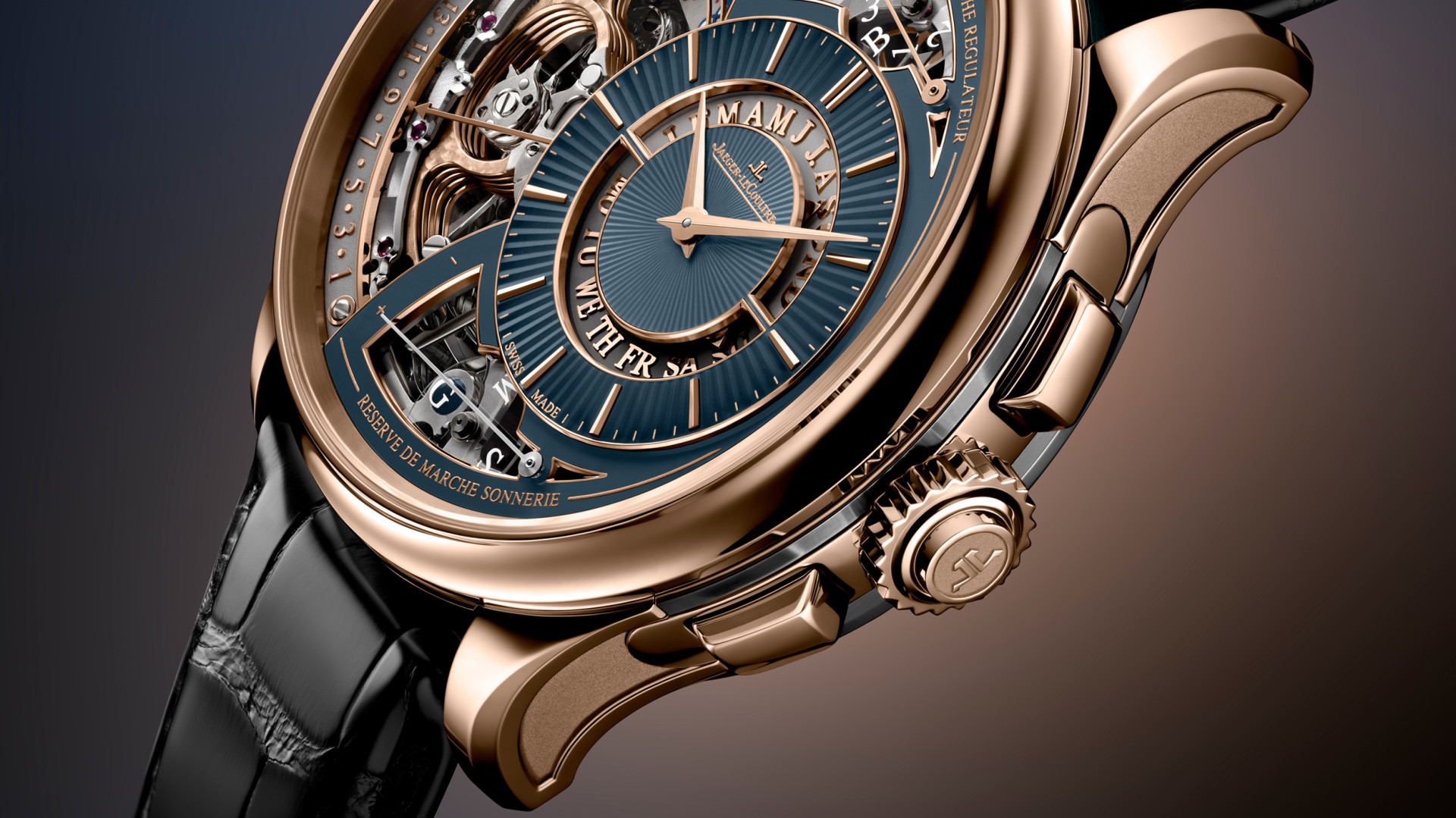
Intuitive control, exceptional complexity: Because chiming mechanisms are vulnerable to damage caused by misuse, Jaeger-LeCoultre’s engineers equipped Calibre 182 with a selector mechanism to ensure that the mode chosen by the user at any given time effectively ‘disables’ the other modes. This is indicated by a display at the 6 o’clock position on the dial: M for mise à l’heure (time setting) and three chiming modes – G Grande Sonnerie, P Petite Sonnerie and S silence (which silences the automatic sonnerie chimes but allows the minute repeater to be triggered on demand). In the latest version of Calibre 182, this is supplemented by a new security mechanism for the minute repeater mode that prevents the user from triggering the chime again before the mechanism has ‘reset’ on completion of a previous chiming sequence.
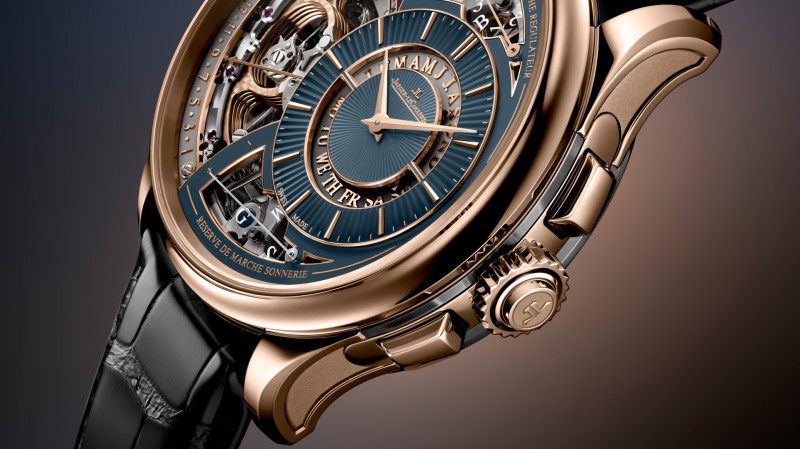
The operation of the various complications is governed by three pushers – two set into the caseband and the third set into the crown – ensuring that, despite its complexity, the watch is intuitive to read and use. Calibre 182 provides energy to the minute repeater directly from the movement; therefore, rather than requiring a traditional slide in the caseband that ‘charges’ the repeater’s mainspring, the minute repeater is simply operated by the pusher in the crown. The pusher below the crown acts as the chiming mode selector, indicated on the dial by G, P or S for silent/minute repeater. The normal functions of the crown are also governed by this selector, rather than by pulling the crown into different positions: to wind the watch, the user selects S (which ensures that the automatic, en passant, chiming functions are disabled) and to set the time, the user selects the fourth mode, M – mise à l’heure. The pusher above the crown enables correction of the perpetual calendar day indication. The month and date correctors are concealed between the lugs at 12 o’clock.
A NEW AESTHETIC COMPLEMENTED BY HAUTE HORLOGERIE FINISHING
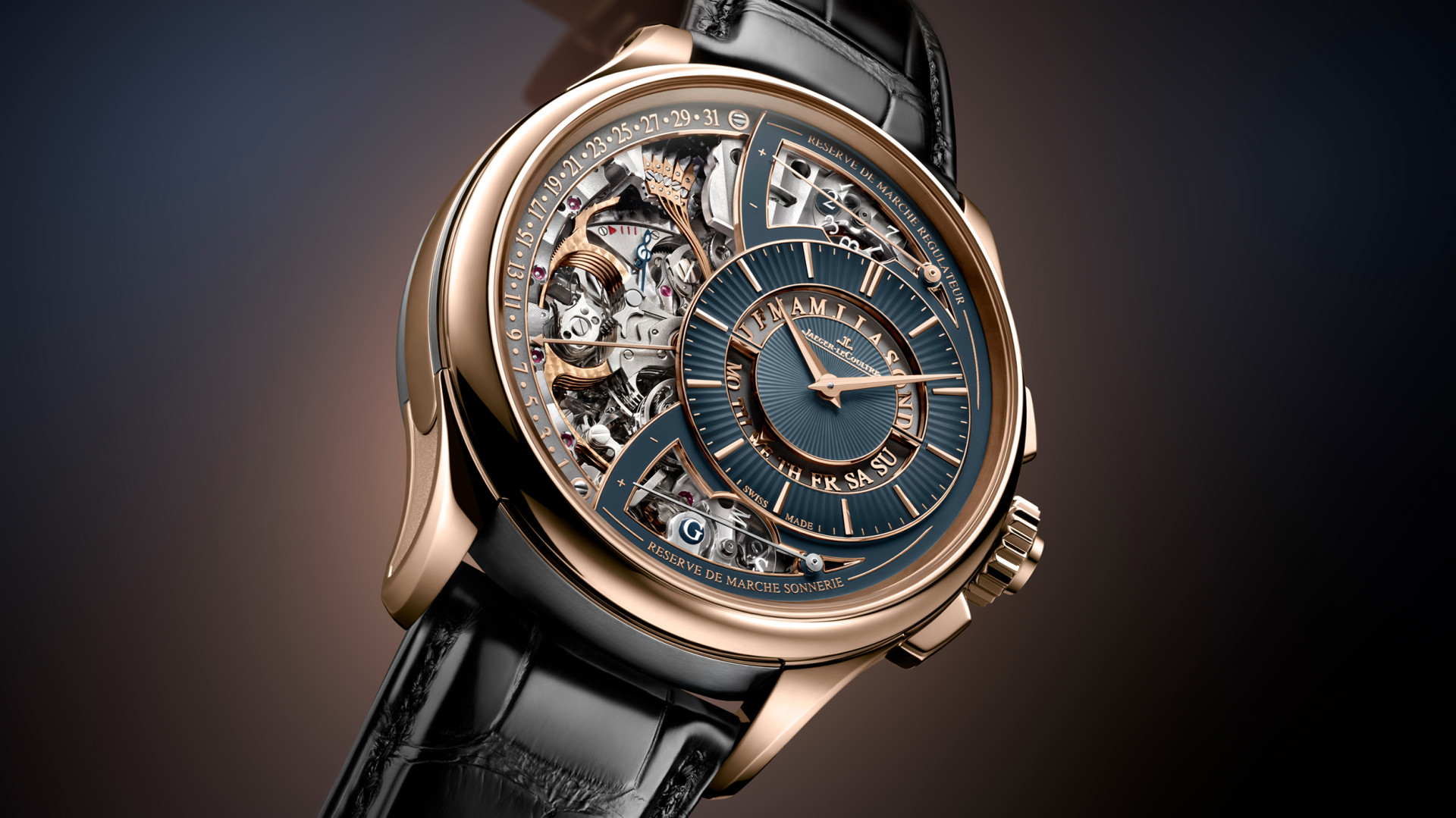
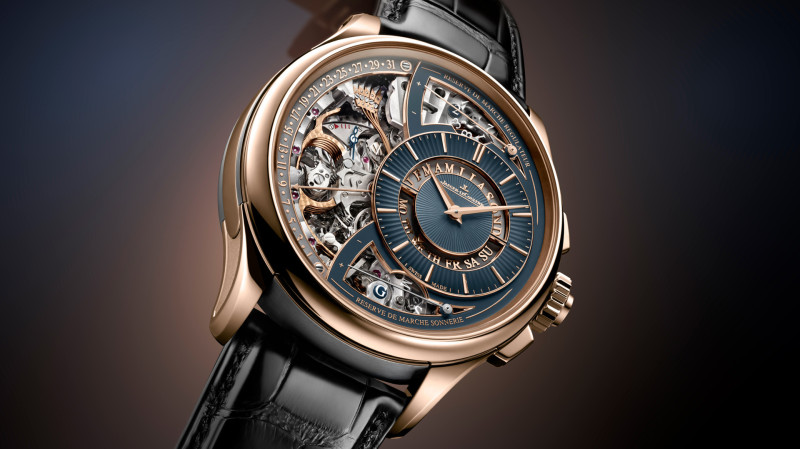
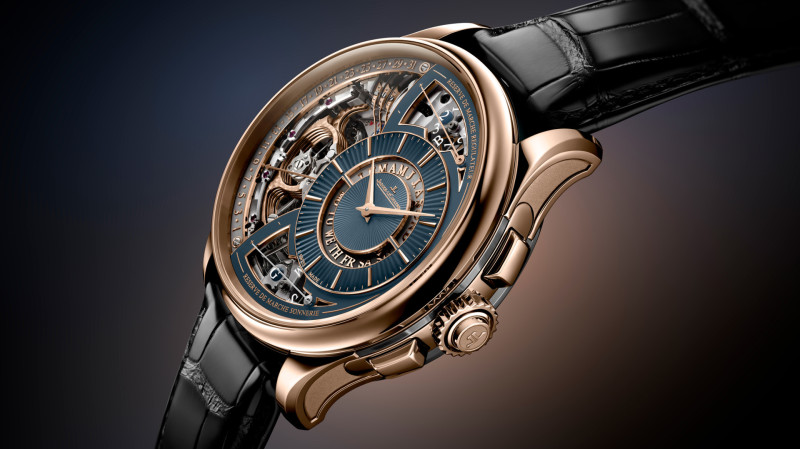
The dial of the new Duometre Grande Complication A Grande Sonnerie is more open-worked than that of its predecessor, revealing more of the beauty and intricacy of the mechanism, while the diameter of the hour-minute-calendar dial has increased by 30 percent to enhance legibility and add balance to the composition.
The principal dial-side and the hour-minute-calendar dial are decorated with dark blue-grey lacquer, which provides a visually sober contrast to the myriad moving parts and pink gold aesthetic – the latter being applied to several components, notably the five racks and their corresponding springs, visible between the 10 and 11 o’clock positions. The centre of the hours-minutes dial is sunray brushed beneath the lacquer and on the outer circle, gradient dark blue lacquer applied over a sunray guilloché provides the background for the applied 18k Pink Gold (750/1000) hour indexes.
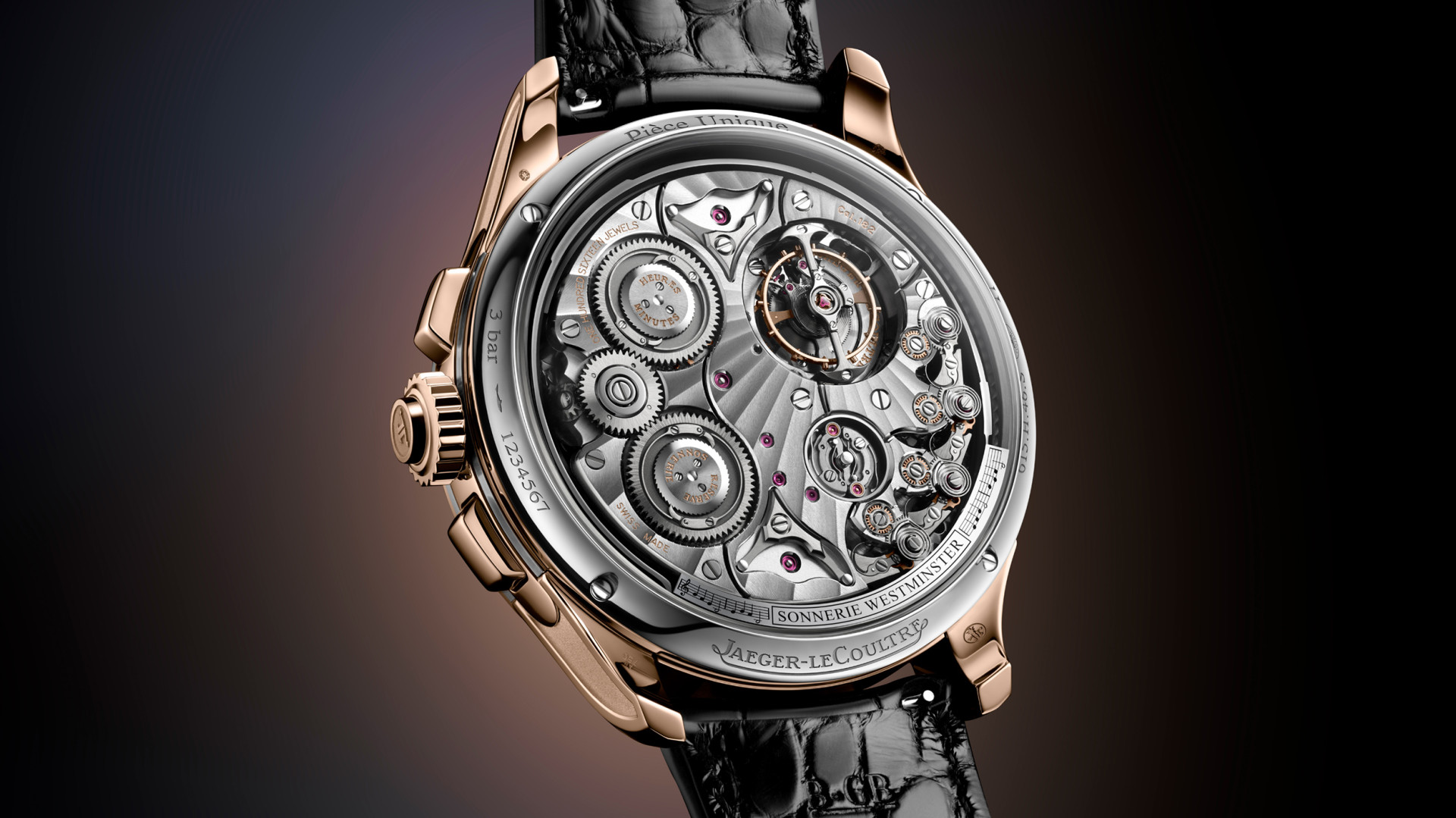
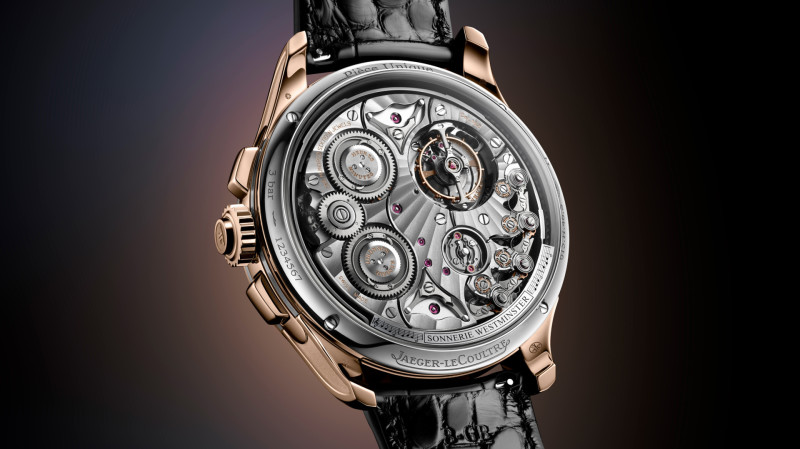
On the periphery of the watch face, the retrograde date indication forms an arc from 7 o’clock to 11 o’clock, laser-engraved on pink gold; the retrograde displays of the days of the week and the months are laser-engraved on a pink gold inner ring on the hour-minute dial, each indicated by a small golden arrow. The two power reserve counters characteristic of the Duometre architecture are open-worked and the leap year display at 12 o’clock, provides symmetry with the chiming mode indicator at 6 o’clock. On the reverse side of the watch, the sapphire crystal case back reveals the flying tourbillon, complemented by meticulous Haute Horlogerie finishing across the movement, including sandblasting, perlage, snailing, 87 hours of hand bevelling work on 251 components, sunk rubies and screws, sunray Côtes de Genève, flat polishing, linear brushing and circular brushing – nine distinct finishes in total.
Echoing the complexity of the movement, the Grande Tradition case is made up of 60 components, combining a titanium case body with 18k pink-gold (750/1000) elements including the lugs, bezel and pushers. The pink-gold components feature a combination of microblasted and polished finishes. The Duometre Grande Complication A Grande Sonnerie is set in a 45 mm case – a remarkable feat of miniaturisation for a 1,300-component calibre – complemented by a black alligator leather strap with the Hybris series’ signature folding buckle that features a patented mechanism to enable fine adjustment for a perfect fit on the wrist.
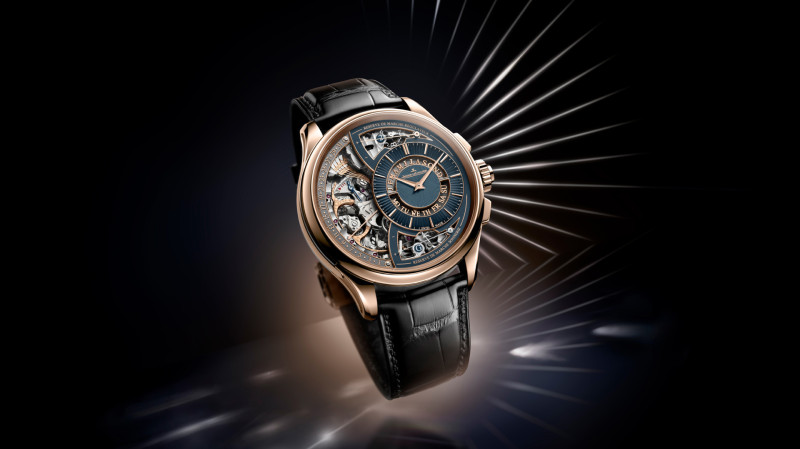
Reaffirming Jaeger-LeCoultre’s mastery of striking watches, built on a legacy of more than 200 different chiming calibres created over the course of 156 years and epitomising its commitment to tradition through constant innovation, the new iteration of the Duometre Grande Complication A Grande Sonnerie is a pièce unique (single-piece edition).
TECHNICAL CHARACTERISTICS
DUOMETRE GRANDE COMPLICATION A GRANDE SONNERIE
Calibre: Manufacture Calibre 182, manually wound, three barrels, flying tourbillon, openworked
Functions: Hours and minutes, Grande Sonnerie, Petite Sonnerie, minute repeater, perpetual calendar
Power reserves: 48 hours (time and calendar functions), 7.5 hours continuous chiming in Grande Sonnerie mode, 32 hours continuous chiming in Petite Sonnerie mode
Case material: 18k 5N Pink Gold (750/1000) with titanium inner body
Dimensions: 45 mm x 16.16 mm
Caseback: sapphire crystal
Dial: Openworked and sunray guilloché dial coated with blue-grey lacquer
Time and calendar dial: dark blue-grey lacquer with gradient and sunray-brushed segments
Strap: Black alligator with 18k Pink Gold (750/1000) folding buckle incorporating micro-adjustment mechanism
Reference: Q603H480
Single-piece edition
Downloads

|
|
|
|
|
|
|
|
|
|
|
|
|
|
|
|
|
|
|
|
|
|
|
|
|
|
|
|